A first-hour Deskrawl checklist from the 1.0 build: life skills to buy, talents to skip, the carriage filter, and what the game automates for you.
Deskrawl Beginner Guide: What to Unlock in Your First Hour
Spend your first 650 gold opening the four starter branches of the Life Skill tree, then 1,500 more on the Equipment Auto-Sell node, then push the world map one zone at a time. Two things quietly eat a new player's first hour: hunting for an "Equipment Auto-Filter" life skill that does not exist as a node in the 1.0 build, and spending gold on sockets and runes that are hard-locked until level 30 and level 40 respectively.
Every number below is read from the 1.0 launch build's own data assets (2026-09-28). The live client has been on patch 1.0.0g since 2026-09-29, so treat these as the launch baseline and expect small drift.
- Buy, in this order, at node price: tree root (50g) → Gold Find I, Item Find I, XP Gain I, Revive Cooldown Reduction I (150g each) → Auto Refill (500g) → Expedition Camp (750g) → Equipment Auto-Sell (1,500g). Those eight nodes cost 3,400 gold in total: 50 + 4 × 150 + 500 + 750 + 1,500. Every price here is the
GoldCostsfield of that node'sLifeSkillNodeDataasset in the 1.0 launch build, and the order is legal because each node'sPrerequisiteis already in the list ahead of it. - Do not buy yet: a storage page (20,700g from zero) or an auto-salvage node (50,700g from zero) — each costs more than that whole route combined.
- Do not even look at: gem sockets (level 30), rune drops (level 40), Nightmare difficulty.
- Progress by clearing, not grinding: the world map is one unbranching chain of 70 maps.
The Four 150-Gold Nodes That Gate the Whole Tree
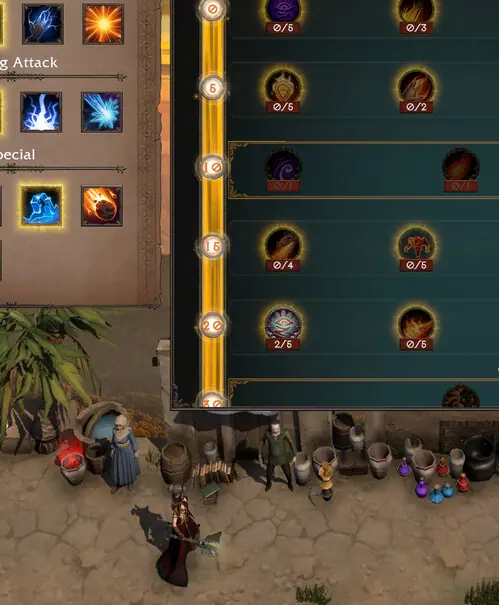
The Life Skill tree is not a grid you fill in any order. It is 85 LifeSkillNodeData assets wired as a genuine prerequisite tree — 84 of the 85 carry a Prerequisite pointer to a parent, every node has MaxLevel = 1, and each stores a single flat GoldCosts value rather than a per-level price. There is no respec: you buy a node once and it stays bought.
Only four nodes hang directly off the root, and the three columns that matter are different numbers — do not mix them:
| Node | Official display name | Grants | Node price | Cost to own this one alone | Running total, all four |
|---|---|---|---|---|---|
| Tree root | Auto Recovery | Full health on returning to town | 50 | 50 | 50 |
| Branch A | Gold Find I | Flat +0.1029 Gold Find (display token formatted as a percentage, so it reads as 10%) | 150 | 200 | 200 |
| Branch B | Item Find I | Flat +0.1211 Magic Find (≈12%) | 150 | 200 | 350 |
| Branch C | Revive Cooldown Reduction I | −1.6s off the revive timer (stored value 1.5647, token format 0.# with an s suffix) |
150 | 200 | 500 |
| Branch D | XP Gain I | Flat +0.0995 XP Gain (≈10%) | 150 | 200 | 650 |
All four hang off the same parent — the root — with no node between them. So each costs 200 gold to own outright (50 for the root, plus its own 150), and 650 only exists once you have bought all four. That is the highest-value spend in your first hour: it makes every later node purchasable, and each branch then grows independently.
The tier-two nodes carry the Notable suffix in their asset names (GoldFindNotable, MagicFindNotable, XPGainNotable) and cost 8,000–25,000 gold each, versus 150 gold for the tier-one node on the same branch. They are not strictly upgrades of tier one — Material Find I stores +0.4631 while Material Find II stores +0.2588, because the two sit on different branches rather than one feeding the other. The full node-by-node tree is here.
Auto-Sell Is the First Real Purchase, Auto-Fill Is the Second
Once the four branches are open, the next buys in rough order of return. The last column is the game's own node description, quoted from the localization table, so you can check the wording in-game:
| Purchase | Node price | Cost from zero, cheapest route | What the node does |
|---|---|---|---|
| Auto Refill | 500 | 700 | "Automatically refill potion charges after returning to town or being revived from death." |
| Capacity I | 500 | 700 | "Increase Carriage Capacity by {value}" — a flat +1.549 on StatType.Capacity |
| Expedition Camp | 750 | 950 | "Gold and experience accumulate based on the highest area you have unlocked, and are collected the next time you enter town." |
| Soul Reliquary I | 1,000 | 1,200 | "Increase Soul Shard carry limit by {value}" — a flat +100 |
| Equipment Auto-Sell | 1,500 | 1,700 | "automatically sells equipment of the selected rarities the moment the carriage picks it up" — "Sold equipment does not take up carriage space." |
| Combat Potion Auto-Use Slot | 2,500 | 2,700 | "Unlock a slot for a combat potion, which is used automatically during combat whenever its buff is not active." |
| Auto-Fill Inventory | 6,000 | 7,700 | "When the Carriage is full, newly collected loot is sent to your inventory when space is available." |
"Cost from zero" counts the root plus any prerequisite nodes you would have to buy to reach the target — which is why Auto-Sell reads 1,700 there and 1,500 in the opening line. Note what Expedition Camp actually says: offline gold and XP accrue from the highest area you have unlocked, not the zone you left your character standing in.
Auto-Sell is the one to buy first, and the in-game hint is explicit about why: "Auto-Sell turns gear into gold and Auto-Salvage breaks it down into materials the moment the carriage picks it up, even during combat. Neither takes up carriage space." Gear you never pick up costs zero carriage space, and carriage space is the real bottleneck early — normal enemies drop nothing at all 87.4%–95% of the time.
A long-running Steam thread titled "Bug Report - Auto Fill inventory not working" was opened on June 30, before launch. The original poster bought the node, ran the game idle overnight, and found a full carriage and an empty inventory. Four more players agreed through September 22. Then three players reported it working on September 26, 27 and 28 — with one adding that it "picked up everything no matter the filter settings." That last remark lines up with what the build actually ships: see the next section.
The Carriage Filter Exists — the Node to Unlock It Does Not
The carriage filter panel is free and always open. Its label is Equipment Filter, and it sets one action per rarity: Pick Up, Auto-Sell or Auto-Salvage. The hint text ends with "Learn Life Skills to unlock new filter actions" — Pick Up is your baseline, and the other two actions are the gated ones.
Those gates are explicit in the decompiled LifeSkillFeature enum, which has exactly six members:
LifeSkillFeature |
Value | Node that grants it |
|---|---|---|
AutoTownRecovery |
0 | Tree root (50g) |
AutoTownPotionRefill |
1 | Auto Refill (500g) |
CarriageAutoFillInventory |
3 | Auto-Fill Inventory (6,000g) |
CarriageAutoSell |
4 | Equipment Auto-Sell (1,500g) |
OfflineRewards |
5 | Expedition Camp (750g) |
CarriageAutoSalvage |
6 | Equipment Auto-Salvage (35,000g) |
There is no CarriageAutoFilter member. The localization table ships a string for it — EnableCarriageAutoFilter, "Equipment Auto-Filter", "Enable Carriage Equipment Auto-Filter, so that it can collect equipment matching the selected rarities and leaves the rest on the ground" — alongside 36 other life-skill names. But that string is not backed by a LifeSkillNodeData instance, an effect asset, or a feature flag anywhere in the launch build. Of the 37 localized life-skill names, 36 have effect assets, and 35 of those are wired into a node at all.
So: set the filter per rarity from minute one, and do not hunt for a node that grants it. One player's "picked up everything no matter the filter settings" is consistent with the same gap, but it is a single forum post, not a confirmed bug.
Clear the Map, Don't Grind the Level
Zone progression is a hard single line. Every combat map in the chain carries exactly one MapData.Prerequisite — Forest1 is the only one with none — and walking it from the start produces an unbroken 70-map chain with no forks, from Forest1 to Volcano7. The only three branch points lead off the line, to the Dreamy treasure zones.
| # | Region | Maps | Enemy level band | Gate on the last map |
|---|---|---|---|---|
| 1 | Kings Woods | 7 | 1–10 | Demon Skull |
| 2 | Spire Hill Crypt | 4 | 11–16 | — |
| 3 | Spire Hill Crypt Lower | 3 | 17–19 | Demon Skull |
| 4 | Kings Woods South | 7 | 20–28 | Demon Skull |
| 5 | Tazan Wastes | 7 | 28–34 | Demon Skull |
| 6 | Tazan Isles | 7 | 34–40 | Demon Skull |
| 7 | The Barrens | 7 | 40–46 | Demon Skull |
| 8 | The Crimson Vale | 7 | 46–52 | Demon Skull |
| 9 | Veldak Highlands | 7 | 52–58 | Demon Skull |
| 10 | The Defiled Keep | 7 | 58–64 | Demon Skull |
| 11 | The Cinder Crown | 7 | 65–70 | Demon Skull |
Exactly 14 of the 82 map assets carry a non-empty EntryRequirements: the ten finales above, the Mythic Rift, and the three Dreamy zones. Each finale asks for one Demon Skull, with a difficulty-matched variant — Skull on Normal, SkullNightmare on Nightmare, SkullInferno on Inferno1. Nine regions have exactly seven maps; the Spire Hill Crypt is the exception, split 4 + 3.
Because the bands run 1 to 70 without a gap and the door is the map rather than the level, sitting in zone one grinding past level 10 buys you nothing you can walk through yet. The full zone-by-zone level order is here, and the skull rules are in the Demon Skull entry guide.
Talents Are Free to Experiment, and Capstones Are Cheaper to Swap Than You Think
The talent system is the opposite of the life skill tree. All 185 TalentData assets have an empty Prerequisite — there is no talent prerequisite tree at all. Unlocking is purely a LevelRequirement check, and points go into MaxPoints slots running from 1 up to 10. Nothing you pick can lock you out of anything else.
The only real restriction is ExclusiveGroup, and it is narrower than it sounds. There are exactly three groups, gated at three exact levels:
| Exclusive group | Unlocks at | Talents in it | Points per talent |
|---|---|---|---|
Capstone10 |
level 10 | 13 | 1 |
Capstone30 |
level 30 | 12 | 1 |
Capstone60 |
level 60 | 16 | 1 |
GameConfig.TalentRefundCostPerPointSpent is 8 gold per point spent, and since every capstone is a single-point talent, swapping one costs exactly 8 gold. The UI describes the flow as "Left-click to replace {0} for {1} gold. Allocated points transfer to this talent; excess points are refunded," and the rule as "Choose one capstone per layer. Choices in other layers are independent."
The one hard stop is a dependency lock, not gold: the game refuses a swap with "Cannot replace this capstone while other talent requirements depend on the current allocation."
That is inside your first session, and 8 gold makes it reversible. What is worth waiting on is the layers at 30 and 60: LevelRequirement on the talent table runs to 100, past MaxPlayerLevel of 70, so the tree keeps taking points long after the level cap.
Gold You Should Not Spend Yet
Three things look affordable and are not, because of hard level gates in the config:
- Gem sockets require item level 30 (
ItemizationConfig.MinLevelForSockets), and only six of the eleven slots can hold them at all — see the gems and sockets guide. - Runes start dropping at level 40 (
LootConfig.RuneDrops.MinDropLevel), with the first rune slot unlocking at 40 as well. - A second storage page costs 20,700 gold from zero, and
Storage.Capacityis 50 across 5 pages.
Difficulty is gated too, and not by level: the unlock hint reads "Clear the final boss on {0} to unlock," and difficulties can only be switched inside town. Nightmare is not a first-hour decision. The offline earnings guide covers the AFK side — the 8-hour base cap plus two +2-hour nodes and one +4-hour node tops out at 16.
Equipment Upgrades Are Free Through +4
One last freebie while you are low level. GameConfig.UpgradeSuccessChances is a ten-entry array for +1 through +10:
| Upgrade | +1 | +2 | +3 | +4 | +5 | +6 | +7 | +8 | +9 | +10 |
|---|---|---|---|---|---|---|---|---|---|---|
| Chance | 100% | 100% | 100% | 100% | 75% | 50% | 40% | 30% | 20% | 10% |
The first four are guaranteed. Take every cheap drop to +4 in your first hour without thinking about it, and read the full upgrade chance table before you go past that.
FAQ
Should I pick a specific class in my first hour? Not here, and not anywhere yet: the game launched on 2026-09-28 and there is no reliable meta three days in. All four classes share one ability ladder — abilities unlock at levels 1, 5, 10 and 15 in five-level steps, and you have four ability slots — so the class gates nothing in hour one. Pick what you like, and read the difficulty guide when a final boss is in sight.
Do I need to buy the carriage filter first, before anything else? No, and you cannot. There is no filter node to buy in the 1.0 build. The filter panel itself is free and lets you set Pick Up, Auto-Sell or Auto-Salvage per rarity from the start; what costs gold is unlocking the Auto-Sell and Auto-Salvage actions inside it.
Is the Auto-Fill Inventory node broken? Community reports are split, and the oldest ones are from the pre-launch build — see the callout above for the full timeline. If your carriage genuinely fills and your inventory stays empty, check first that the carriage really is at capacity rather than simply holding everything it picked up.
Should I level to 10 before buying anything? No. The four 150-gold nodes and their 50-gold root are what unlock the rest of the tree, and you want them bought before your carriage fills rather than after. Everything beyond Auto-Fill Inventory can wait.
What about the minions that pull the carriage? Worth grabbing as they appear, because carriage capacity is the real constraint early. But capacity nodes are separate purchases from the automation nodes, and the numbers are on the minions and carriage capacity page.
Related Guides
- Deskrawl Life Skills Tree: all 85 nodes and where Gold Find actually sits
- Deskrawl Zones and Level Order: the 70-map chain with a level band for every map
- Deskrawl Talents: why there are no prerequisites and what each capstone layer costs
- Deskrawl Offline Earnings: the 8-hour cap and the nodes that take it to 16
- Is Deskrawl Worth It: whether to spend the first hour at all
Official source: Deskrawl: Idle ARPG on Steam and the 1.0 launch announcement. Player reports quoted here come from the Auto-Fill bug thread on Steam Discussions, a community source, not an official statement.
More Deskrawl: Idle ARPG Guides
Deskrawl has exactly three difficulties. Inferno multiplies enemy HP sixfold and is the only tier that drops Divine gear, rune sets and Mythic content.
The real Deskrawl loot table from the 1.0 build — 87-95% no-drop rolls on trash mobs, chest contents, and what patch 1.0.0g actually changed.
The verified Deskrawl +10 upgrade table: four guaranteed levels, then 75%, 50%, 40%, 30%, 20% and 10% — plus the material each slot needs.
The 68 official Deskrawl stat affixes and the per-slot roll pools, plus the 11-vs-12 equipment slot puzzle solved: rings occupy two slots.
Exact Deskrawl socket costs from the 1.0 build: 100 ore plus 400 gold per item level, level 30 to unlock, and the five slots that cannot be socketed.
There is no gold map in Deskrawl. Gold comes from offline mob rolls scaled by difficulty bonus, Life Skills gold find, and the lucky wheel.
Deskrawl has six rarity tiers ending in Divine, not Epic. The Divine drop chance, its Inferno-only gate, and why you should never salvage one.
The Deskrawl Life Skills tree explained: 85 official nodes, 84 with prerequisites, hidden until unlocked, and why only 0.9% of players have finished it.